
🎸 Dealer Count Is a Vanity Metric

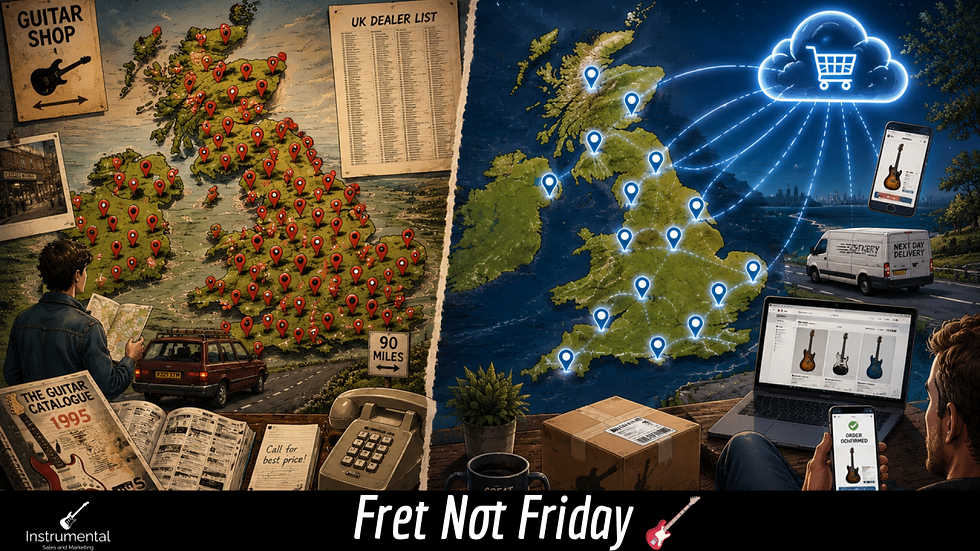
There was a time when the size of your dealer network genuinely mattered.
If you wanted to build a successful guitar brand in the UK during the 1980s, 90s or even the early 2000s, you needed dealers everywhere. Manchester. Birmingham. Glasgow. Bristol. Norwich. Plymouth. Belfast.
The first question wasn't, "Who has the best website?" It was, "Where can I actually see one?"
If you lived in Cornwall and the nearest dealer was in Bristol, there was a good chance you simply weren't buying that guitar. If you wanted to compare three brands side by side, they all needed representation within driving distance.
Dealer networks weren't just about selling products. They were about making products physically accessible, and every good dealer you added genuinely increased the number of customers who could discover, try and buy the brand.
Mail order grew steadily through the likes of Turnkey, Flying Pig, Digital Village and Dolphin Music, but for most of the trade, business still came through the front door. Geography was the problem, and a strong dealer network solved it. That made perfect sense at the time.
Then the problem dealer networks were built to solve almost disappeared, not because shops got worse but because customers changed how they bought.
The internet didn't just add another sales channel. It removed geography as one of the biggest barriers to purchase. Today, almost every serious retailer sells nationwide through their own website, marketplaces like reSound, Reverb and eBay, finance options, next-day delivery, YouTube and social media. A guitarist in Penzance can buy from Glasgow just as easily as from Plymouth.
Customers no longer ask, "Who's my nearest dealer?" More often they ask, "Who's actually got one in stock?"
That's a fundamental shift, and it raises a question I don't think we ask often enough.
What problem is a big dealer network actually solving today?
📊 The Vanity Metric
I still see brands measuring success with a number that belongs to a different era.
"How many dealers have we signed this year?"
It's often one of the first questions people ask, as if dealer count automatically equals market share. I'm not convinced it does any more.
Dealer numbers are easy to measure. Dealer quality isn't. Which is exactly why the first becomes a KPI and the second becomes an afterthought.
I'd rather have twenty dealers who genuinely believe in the brand than a hundred who simply have an account. Twenty who reorder consistently, display the range properly, invest in stock, train their staff, create content and pick up the phone when they need support.
That isn't just a dealer network. That's a partnership, and partnerships build brands.
By contrast, a long list of stockists who ordered once, stuck two guitars in a corner and never engaged again might look impressive on a dealer locator, but it rarely builds a brand. As I wrote last time, two guitars does not make you a dealer.
📈 Growth Has a Cost
Every new dealer sounds like progress. Sometimes it is. Sometimes it isn't.
Every new account also needs time, training, marketing support, stock planning, relationship-building and problem-solving. None of that scales for free. The more dealers you add, the thinner those resources become unless the business grows alongside them. Signing another fifty dealers is relatively easy. Helping fifty dealers become genuinely successful is much harder, yet that's the part most growth conversations skip over.
Maybe the question isn't how many dealers you have. Maybe it's how many reorder consistently, how many actively recommend the brand, how many present it properly, how many customers walk through the door specifically to see it, and how many would genuinely miss it if it disappeared tomorrow.
Those are the numbers that tell you whether you've built a network or simply accumulated accounts.
A locator entry is easy to get.
A dealer who genuinely fights your corner in front of a customer is not.
And that difference rarely shows up in a spreadsheet.
🎯 The Reality Today
I work with dealers every day, so this isn't black and white to me. There will always be strategic reasons to add new accounts, improve regional representation or enter new markets, and there are markets where a thin dealer network genuinely does hold a brand back. I'm not arguing that dealer numbers don't matter at all.
For categories like strings, picks, cables and batteries, broad availability still matters hugely. If someone needs a replacement today, convenience wins, and no amount of brand loyalty survives an empty shelf when the customer needed it an hour ago.
But for a considered purchase like a guitar, bass or amplifier, the decision looks different.
Customers research, compare, watch reviews and often already know exactly what they want before they ever speak to a dealer.
What they need from that dealer isn't proximity.
It's confidence.
And confidence comes from someone who genuinely knows and believes in the product, not someone who simply happens to have two of them in stock.
That's why dealer quality now matters far more than dealer quantity.
A lot of the industry is still building dealer networks designed for 1998, chasing coverage on a map that stopped mattering the moment customers stopped needing to be near a shop to buy from it.
The market has moved on.
Customers have moved on.
The best dealers have moved on.
For most guitar brands in 2026, twenty outstanding, committed dealers will outperform a hundred indifferent ones, and the sooner that gets measured properly, the sooner the effort goes where it actually pays off.
❓ Has your industry become too focused on counting what's easy, instead of measuring what really matters?


Comments