
🤖 Your Marketing Looks Perfect. That's the Problem. 🎯


D'Addario recently found itself at the centre of a row over a promotional video for its new NYXL HD strings.
Some viewers believed the music had been generated by AI. D'Addario denied it, insisting real musicians played and recorded the guitars over MIDI-programmed drums and synths, plugins and a fair amount of production. The company admitted the demo had been over-produced, and that the decision had backfired.
That should have settled it. It didn't, and this week it came apart completely.
After a full review, D'Addario admitted that generative AI had been used to create the track after all, regenerated through Suno Studio. "We got this wrong," the company said. "We do not support AI-generated music, and our process will reflect that going forward." It now says it will require staff and creative partners to disclose any use of generative AI.
I've no interest in piling on. D'Addario have now done the right thing by acknowledging what happened, and their commitment to disclosure is exactly what this moment needs.
What interests me is everything that happened before that, because it tells us something much bigger about modern marketing.
The audience raised a legitimate concern.
The brand denied it.
The audience's instinct turned out to be right.
The problem wasn't simply that AI had been used. It was that the audience questioned what they were hearing, received a firm denial, and ultimately turned out to have good reason to question it.
Whether that denial came from bad information, a broken approval process or something else almost becomes secondary from the customer's point of view. Once an audience senses something isn't real and gets told otherwise, the damage isn't limited to one video. It spreads to whether they believe anything you show them next.
There's another lesson in there for brands too. If you're going to categorically deny something, you'd better be absolutely certain the information travelling up through your own business and creative partners is accurate.
In an age of outsourced content and increasingly invisible AI tools, "we didn't know" might explain what happened. It won't necessarily repair the trust afterwards.
🧰 Everyone Has the Tools
Marketing has never been easier to produce. A phone can shoot high-quality photos and video. Editing software that once required specialist skills is now available to almost anyone. Websites come from templates, adverts launch in minutes, and AI can generate copy, artwork, music, voiceovers and endless variations of a campaign before lunch.
I use AI regularly and it's an incredible tool. Used well, it makes a good marketer more productive and a small business far more capable.
But there's a difference between using AI to help make a campaign and using it to replace the very people your industry exists to serve.
In music, that line matters more than in most industries.
A music brand replacing musicians with generated performances, then presenting them as the real thing, isn't just a production shortcut. It cuts directly across the authenticity the audience came for in the first place.
And that's the trap D'Addario walked into: not simply that the tools were used, but that the performance they were promised wasn't the one they were actually given.
Where AI is used that way, brands have to be honest about it. Not because every use of AI is wrong, but because trust depends on audiences understanding what they're actually being shown.
📈 The Barrier Has Moved
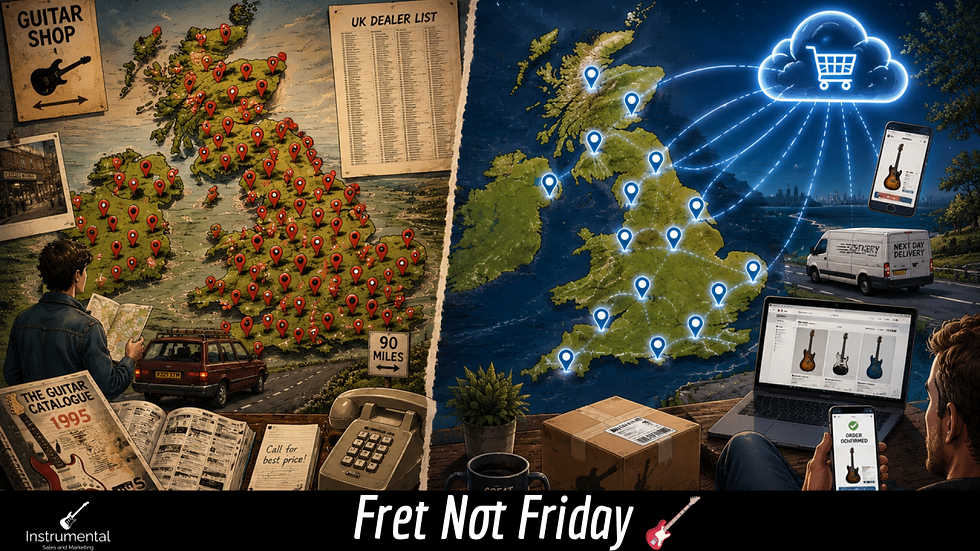
Twenty years ago, the hard part was production. Good photography cost money. Video meant equipment, skills and editing time. Print had to be designed, booked and paid for. Reaching a large audience meant buying access to one.
That barrier has largely gone.
The new one is getting anyone to care.
Businesses can now make more content, faster and cheaper than ever. Unfortunately, so can everyone else.
The result is an overwhelming amount of material, produced by overwhelmed people, for overwhelmed people. Marketing teams feel pressured to post constantly, every platform demands a different format, and every campaign apparently needs a reel, a story, an email, a carousel, a short and another version cut vertically.
The production problem has been solved.
The attention problem has exploded.
And the most obvious symptom is that so much marketing now looks and sounds identical. The same polished product shots, the same quick cuts, the same dramatic voiceovers, the same captions about being "excited to announce" something.
Technology has made it easy for brands to appear professional, and just as easy for them to become interchangeable.
That's the contradiction at the heart of it.
The tools let everyone produce more, yet the more everyone produces, the less distinctive any of it becomes. Marketing has drifted towards filling channels rather than telling stories. Brands ask what they should post this week instead of what they actually stand for, then wonder why the audience scrolls straight past.
🤝 Authenticity Is Becoming the Advantage
"Authenticity" is an overused word, but the principle behind it has never mattered more.
It doesn't mean poor production or filming everything badly on a phone. It means what a brand shows feels connected to what the brand actually is: a real product, a real opinion, a real person, a real performance, and a story that couldn't simply be copied and pasted onto a competitor's account.
That's getting harder to hold onto, because the pressure to produce more pushes brands to outsource their voice to templates, agencies, algorithms and machines.
And the more polished everything becomes, the harder customers look for something human underneath it.
It's why a raw demo can build more confidence than a cinematic one, why a knowledgeable member of staff speaking honestly can outperform a scripted corporate video, and why audiences often trust independent reviewers and imperfect clips more than material that's been processed until nothing recognisable remains.
Professionalism still matters.
But perfection can now create suspicion.
🤖 AI Can Amplify a Brand. It Can't Create One.
AI can make a small team faster, cut costs, and take the repetitive work off a marketing department's hands.
What it can't do is decide what makes your business worth caring about.
It can't give you a genuine history, manufacture long-term trust, or replace the relationships you've built with customers, dealers and musicians. And it can't save a business that never worked out what makes it different.
If anything, it exposes that problem faster.
When every brand uses the same tools and prompts, the technology stops being the advantage.
The advantage moves back to the things that are harder to copy: experience, judgement, reputation, a clear story and the nerve to show some personality.
🎯 More Content Is Not the Answer
The lesson from the D'Addario row isn't that brands should avoid polished production, or that AI has no place in marketing.
It's that audiences now walk into every marketing interaction carrying doubt, and this time that doubt was justified.
They know images can be generated, voices cloned, reviews written by machines and music made without musicians. So looking professional no longer guarantees feeling credible, and denying what people can already sense only makes it worse.
Trust has to be demonstrated.
Sometimes that means showing the process. Sometimes using less production, not more.
Sometimes being upfront about where AI was involved before someone else forces the issue. And sometimes just letting the people behind the business sound like people.
Marketing has never been easier to make.
But between the pressure to produce endlessly, the volume hitting customers and the growing suspicion around what's real, it has never been harder to make something that earns genuine trust.
The answer isn't more content.
It's more identity, more honesty, and more willingness to tell your own story instead of borrowing the one everyone else is already telling.
Strip away the production, the templates and the trends.
Would your customers still recognise you?

Comments