
Stop Treating the Symptoms (MI’s Real Issue Isn’t What You Think)


Why the industry keeps treating the symptoms while ignoring the cause.
Last time we talked about the guitar industry’s “midlife crisis.” This week, I want to go deeper into the reason the crisis exists at all:
MI keeps misdiagnosing the real problem. And if you diagnose the wrong thing, you fix the wrong thing.
The industry doesn’t have a pricing problem.
It doesn’t have a stock problem. It doesn’t have a marketing problem.
In my opinion... it has a misalignment problem. 🔧
I keep seeing both brands and retailers attempting to fix what’s visible, not what’s vital
Every time the industry feels pressure, it jumps to the same old surface-level fixes:
• 💸 Discounts
• 🎨 Limited finishes
• 📦 Range refreshes
• 🔥 Clearance events
• 🎥 Hoping a YouTube review goes viral
• 📱 “Digital strategies” that are just more random posts
These aren’t solutions. They’re just painkillers.
And as any good GP knows… if you’re handing out painkillers, you’re already too late. The illness remains.
“We need more footfall!”
Nope, you need more relevance. 👀
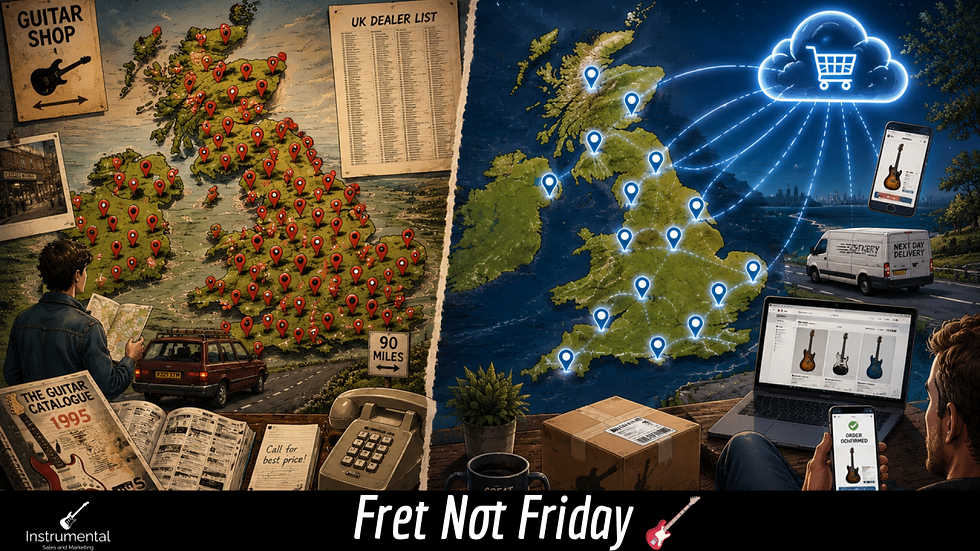
Retailers tell me footfall is down. Of course it is.
The high street has changed for all businesses.
Player behaviour has changed. Attention habits have completely changed. 📉
Yet many businesses still behave like it’s 2003: Static websites, slow content, inconsistent stock
presentation, and an over reliance on walk-ins to save the day.
The truth?
If a potential new customer doesn’t discover you online, they’ll never discover you at all.
And that’s not about footfall, that’s about relevance.
This is where reSound matters, not just as a place to list and sell stock, but as a place to be found: to extend reach, build trust and open new discovery channels.
Retailers and brands that treat discovery as optional will keep losing. Those that treat discovery as essential will win.
“We need cheaper products!”
Nope, you need clearer storytelling.📖
Brands see soft sales and rush to shave £20 off a model. It never works.
Because the next generation doesn’t buy on price they buy on identity. 🎭
Does this product make me feel like the player I want to be?
Does this brand speak my language?
Does this product have purpose?
Tonewood isn’t the story.
Heritage isn’t the story.
A celebrity signature isn’t the story.
The story is: Why does this matter to me?
Brands with strong storytelling and brand proposition are growing. 📈
Brands with catalogues full of “updated colours and slightly updated specs” are fading.
And again that’s not a pricing issue. That’s clarity.
“We need better reviews!”
Nope, you need better a better experience both in-store and online. 🎧
The industry loves to fix declining engagement with another batch of influencer reviews.
But many younger players aren’t looking for reviews anymore. They’re looking for a relationship with the brands and shops they buy from. 🤝
Modern buyers expect:
• ⚡ lightning-fast discovery
• 🎬 meaningful content
• 👥 strong communities
• 📺 live video
• 🤳 authenticity over polish
• 🎤 a sense that the brand gets them
You don’t win with more reviews. You win with more relevance. Again, this is why retailer-led content, live selling, and creator-first commerce (like reSound Live) matter. Not because they’re trendy, but because they meet the customer where they already are. 📲
The industry keeps treating symptoms because symptoms are easier 😬
It’s easier to discount than to rethink your brand story.
It’s easier to blame footfall than rebuild your digital presence.
It’s easier to complain about competition than reshape your offer.
It’s easier to ship another finish than design something with actual purpose.
Symptoms are visible. 👀
Causes are uncomfortable. 🤕
But only one of them creates change.
The real diagnosis 🩺
The MI industry doesn’t need:
❌ more promotions
❌ more content
❌ more influencers
❌ more stock
❌ more models
It needs:
✅ sharper identity
✅ clearer value
✅ stronger stories
✅ better discovery paths
✅ new improved retail experiences
✅ faster adaptation
✅ fewer assumptions about “what players want”
✅ shedding the 'this is how we've always done things/I know best' attitude
✅ tools that help retailers and makers compete with platforms far bigger than them
This is the gap reSound is designed to fill not just as a marketplace, but as a modern infrastructure layer for UK MI. 🇬🇧
Treat the real problem or get replaced by someone who will ⚠️
The MI industry keeps waiting for a gentle reset. There isn’t one coming.
The next chapter won’t be written by the companies with the biggest warehouses or the longest histories.
It’ll be written by the ones with the nerve to face the truth:
Most of the industry isn’t losing sales. It’s losing relevance.
Players haven’t disappeared they’ve just stopped looking in the same direction we used to.
And here’s the uncomfortable bit:
The shops that cling to walk-ins will be overtaken by shops that build audiences.
The brands that cling to nostalgia will be overtaken by brands that build identity.
The makers who cling to old school platforms that bury them will be overtaken by those who claim their own space.
The businesses that cling to symptoms will be overtaken by those who fix the cause.
So here’s the line in the sand:
Adapt now or watch someone smaller, faster and hungrier take your place.
This reset doesn’t care how long you’ve been in business. It cares how quickly you’re willing to successfully adapt.
And if that feels uncomfortable?
Good.
Discomfort is a diagnosis. Reinvention is the cure. 🔥


Comments